

AI agents can now discover services, make decisions, and pay programmatically. The next infrastructure challenge is managing the capital those transactions require.
The internet is gaining a payment layer for autonomous software.
With x402, an AI agent can request an API, dataset, model, or service; receive a price; pay from its wallet; and continue working. The exchange can happen within a standard web request, without a checkout page, account registration, or subscription agreement.
This is no longer hypothetical. x402 processed more than 75 million transactions during a recent 30-day period. Software is beginning to participate in commerce as an economic actor.
When agents are expected to pay without interrupting their workflows, funds must be available when an obligation arises. That may mean maintaining an operating balance or providing access to funds under a defined policy.
But agents do not transact continuously. They spend much of their time gathering information, reasoning, coordinating, and waiting. For prefunded agents, part of that operating balance will remain unused between payments.
At a small scale, this is a wallet balance. At enterprise scale, it is working capital.
Every dollar assigned to an agent increases both its operating capacity and its risk boundary. Agentic commerce will require treasury infrastructure that governs how much capital agents can access, where it can move, and when approval is required.
The Working Capital Behind Agent Fleets
The amount of capital an agent requires depends on its workload and funding model. Some enterprises may prefund individual wallets. Others may use shared accounts, spending allowances, or just-in-time funding. Each approach creates different liquidity requirements.
Under a prefunded model, small balances aggregate quickly. Allocating an average of $1,000 across 1,000 agents reserves $1 million in distributed working capital. At 10,000 agents, the same policy reserves $10 million. These figures are illustrative, but they show how wallet architecture can become a treasury decision at scale.
That decision also distributes the same amount of spending authority across the fleet. Enterprises need explicit limits on how much each agent can access, which counterparties it may pay, where funds can move, and when human approval is required.
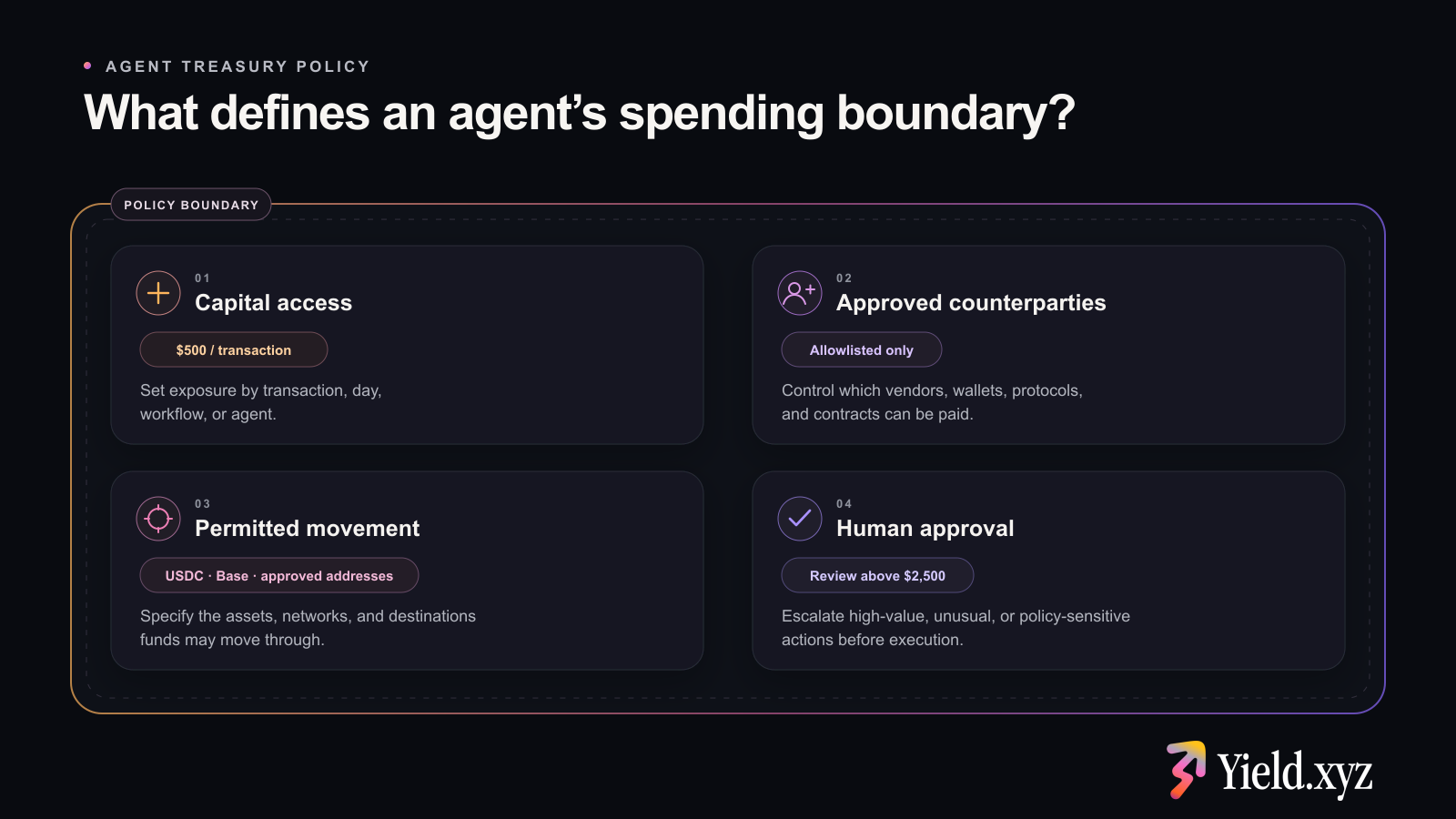
Agent payments occur as discrete events within longer workflows. Between purchases, reserved capital waits for the next obligation while remaining available to the agent.
Traditional treasury teams manage the same tension by matching cash allocations to expected needs. Operating funds remain liquid, while balances with longer time horizons can move into short-duration instruments with appropriate risk and withdrawal terms.
As agent fleets grow, funding, liquidity, permissions, and allocation will need to become explicit treasury policies.
Why Payment Balances Usually Earn Nothing
Stablecoins are well suited to agent payments because they are programmable, available around the clock, and transferable across borders. Most payment stablecoins do not automatically pass reserve income to token holders, so an agent wallet holding them typically receives no return unless the capital is allocated to a separate yield-bearing product.
The GENIUS Act, signed into law in the United States in July 2025, prohibits permitted payment stablecoin issuers from paying holders interest or yield solely for holding, using, or retaining those stablecoins. Reserve assets may generate income for the issuer, but holders do not automatically receive it.
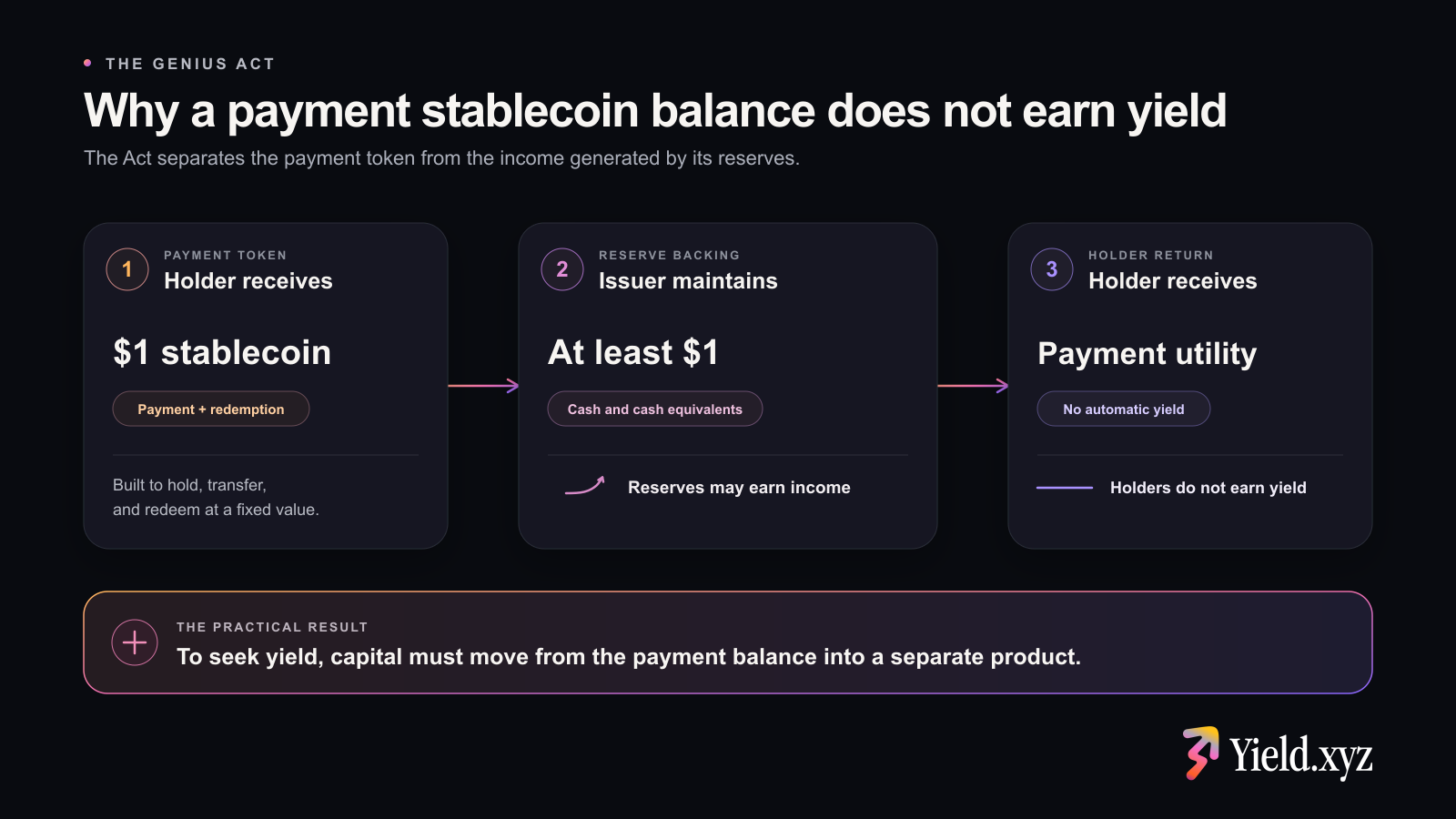
For occasional payments, the foregone return may be immaterial. Across a continuously funded agent fleet, it can become a measurable opportunity cost.
This separation makes treasury management a distinct function. Enterprises must decide how much capital remains immediately available for payments and how much can be allocated elsewhere within their liquidity, risk, and policy constraints.
What an Agent Treasury Must Do
An agent treasury must improve capital efficiency while preserving the agent’s ability to meet its obligations and operate within defined permissions. Five functions support that objective:
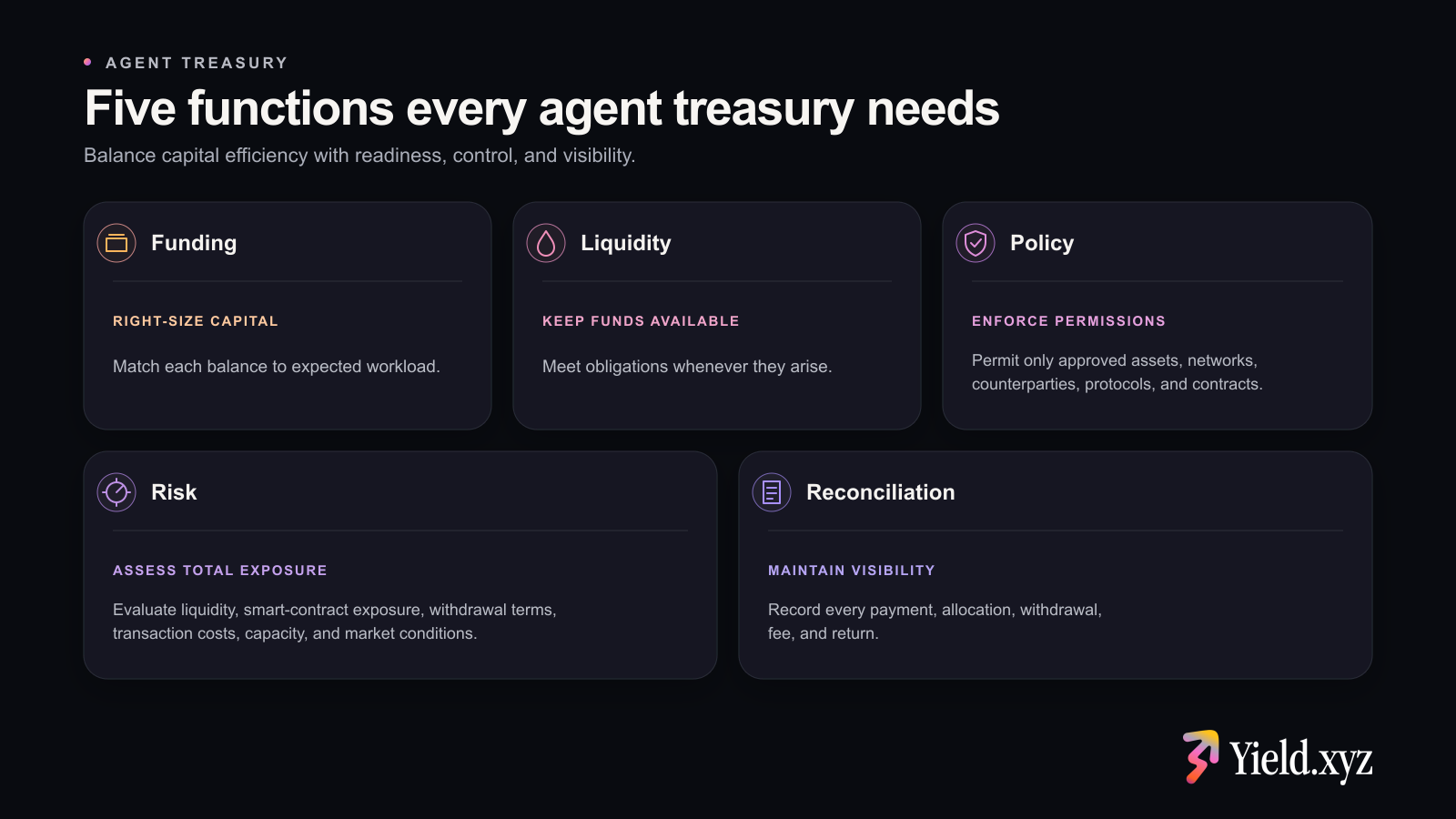
Funding. Each agent needs enough capital to complete its expected workload without carrying an unnecessarily large balance.
Liquidity. Funds must be available when an obligation arises, even when part of the agent’s reserve has been allocated elsewhere.
Policy. Enterprises must define which assets, networks, counterparties, protocols, and contracts an agent may use.
Risk. Decisions must account for liquidity, smart-contract exposure, withdrawal conditions, transaction costs, capacity, and market conditions—not merely advertised yield.
Reconciliation. Every payment, allocation, withdrawal, fee, and return must be visible to finance, risk, and compliance teams.
Enterprises can then manage agent balances as working capital, with every allocation governed by operational needs and policy.
Building the Treasury Layer
Yield.xyz provides one component of this emerging architecture: the discovery and transaction layer for allocating agent capital.
In July 2026, Yield.xyz launched AgentKit support for x402. Through a single MCP server, an agent can discover, evaluate, enter, exit, and monitor more than 3,300 onchain yield opportunities across 80+ networks. These include lending markets, staking, liquid staking, vaults, and tokenized real-world assets such as U.S. Treasuries and money-market products.
Yield.xyz constructs unsigned transactions. The wallet or custody provider retains control over policies, approvals, signing, and execution. Funding and policy remain within the enterprise’s treasury, wallet, and custody systems. AgentKit supplies discovery, diligence, transaction construction, and position monitoring within those controls.
Enterprises can separate capital according to its purpose. An immediate spending balance covers near-term payments. A liquid operating reserve supports variable demand. Longer-duration allocations may be appropriate for funds that are unlikely to be required immediately.
Each allocation must account for liquidity requirements, withdrawal conditions, transaction costs, capacity, market exposure, and smart-contract risk. Yield is one input within that decision.
Within these boundaries, an agent can evaluate opportunities, request allocation or withdrawal transactions, and monitor the resulting positions while signing authority remains with the wallet or custody provider.
From Payment Infrastructure to Financial Infrastructure
McKinsey estimates that AI agents could mediate between $3 trillion and $5 trillion in global consumer commerce involving goods by 2030. Even if agents directly control only a fraction of that value, commerce at this scale will make agent funding and oversight an enterprise treasury concern.
Each enterprise will need to determine how much capital an agent can access, which obligations require immediate liquidity, where surplus reserves may be allocated, and how every decision is approved and reported.
These decisions belong in treasury policy. Wallet and custody systems must enforce that policy through funding limits, permitted assets and counterparties, approval thresholds, and signing controls.
Yield.xyz AgentKit connects those controls to onchain yield infrastructure. Through x402 and MCP, agents can discover opportunities, evaluate their conditions, construct unsigned entry and exit transactions, and monitor positions. The wallet or custody provider retains authority over approvals, signing, and execution.
x402 gives agents a way to pay. AgentKit gives them a way to manage reserves within the policies and custody systems enterprises rely on.