

The infrastructure for open, programmable finance is here. What’s missing is the layer that makes the opportunities, risks, and trade-offs clear enough for people to make informed decisions.
Guided Access to Onchain Finance
The defining story of onchain finance has been access. Over the past five years, the industry has built new settlement rails, lending markets, staking products, tokenized funds, and global payment networks. Stablecoins move value around the clock, while Treasuries, money-market funds, private credit, and other financial assets increasingly exist on public blockchains.
Access is no longer the primary constraint. The harder problem now sits between the market and the person using it: the interface.
Most financial interfaces present options without helping users make sense of them. They show users balances, market data, and hundreds of available products. Then they leave the user alone with the most difficult question: What should I do next?
The next generation of financial products will not work this way. They will not expect every user to navigate markets, compare opportunities, interpret risk, and manage every position alone. Banks, wallets, exchanges, and fintechs will give their users an intelligent financial agent to help them navigate these decisions.
The Judgment Gap
Walk into a private bank and the real product is not custody. It is judgment. The client pays for a team that understands what they own, watches the market, identifies relevant opportunities, explains the trade-offs, and recommends what to do next.
Onchain finance has largely delivered the opposite experience. It gives users direct access to financial markets and then assumes they can act as their own analyst, portfolio manager, risk officer, and operations team.
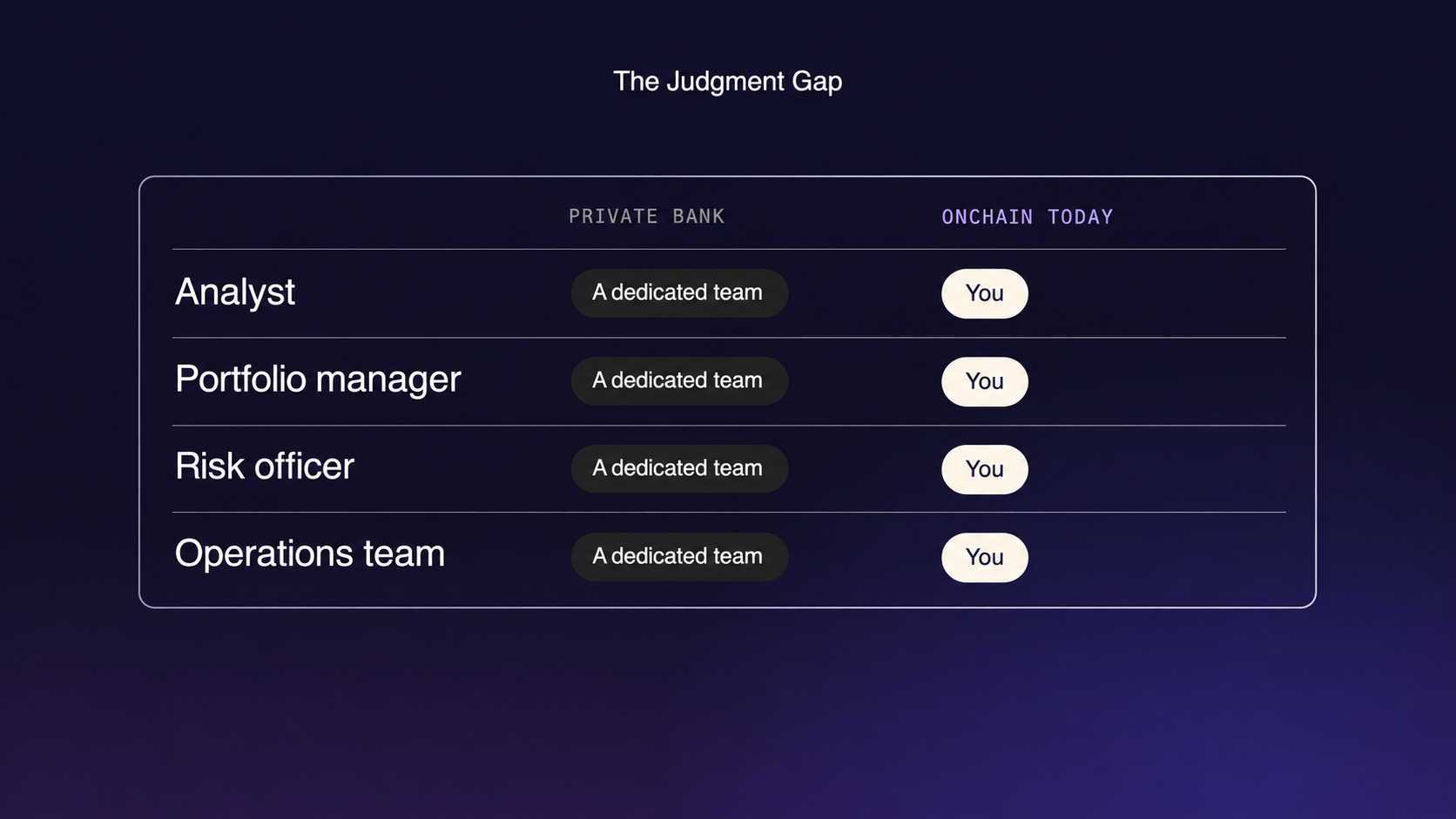
The result is familiar to every financial platform. Users deposit assets but leave them idle. They browse products but often don’t take action. They enter positions they do not fully understand. They lose track of rewards, withdrawal conditions, changing rates, and portfolio concentration. Many eventually disengage because access without guidance creates more responsibility than value.
Generic AI appears to offer an obvious solution. Put a chatbot inside the product, connect it to market data, and let users ask questions. But financial judgment needs additional context to be truly useful.
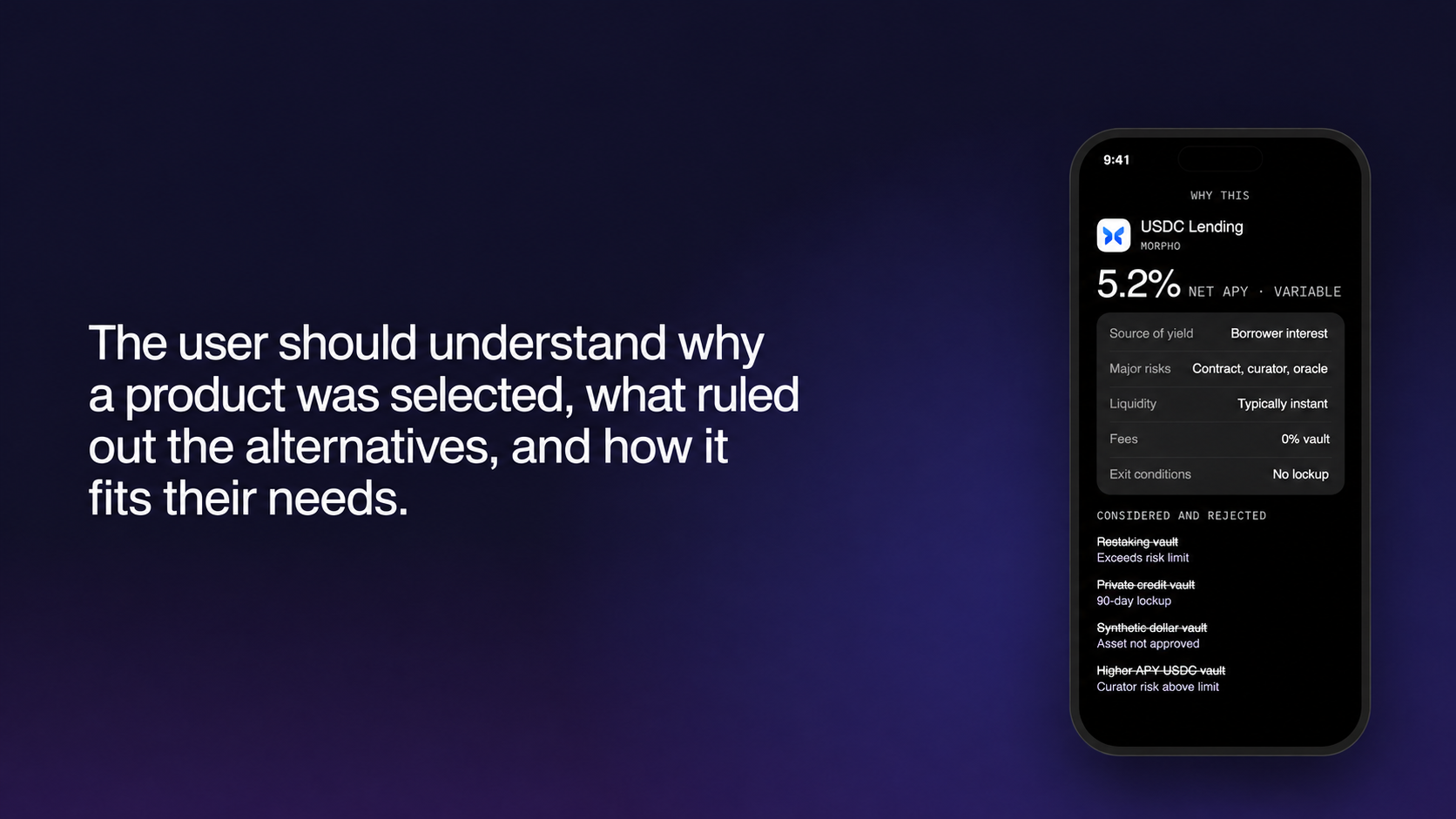
A financial agent needs a live view of what the user actually owns. It needs normalized, execution-ready financial data rather than search results and scraped web pages. It must understand the full lifecycle of a position, including entry, rewards, cooldowns, claims, redemptions, and exits. It must explain recommendations through risk, liquidity, expected return, and credible alternatives. Most importantly, it must operate within boundaries approved by a real person or institution.
Without these capabilities, the agent leaves the hardest work to the user: analyzing the data, understanding the position, and carrying out the transaction.
What Makes a Financial Agent Different
AI agents have demonstrated that models can reason, use tools, and complete multistep tasks. They have also exposed where the architecture becomes fragile: when probabilistic reasoning meets real money.
A coding agent that makes a mistake may generate a failed build or a reverted commit. A financial agent acting on someone’s savings may create an irreversible transaction. The defining question is therefore not only what the agent can do. It is what the agent is allowed to do, who retains authority, and what happens when its reasoning is wrong.
The first principle is that intelligence should remain separate from custody. A financial agent does not need access to a private key. It should understand the user’s portfolio, discover relevant opportunities, evaluate alternatives, and prepare an action. The resulting transaction should remain unsigned until it reaches wallet or custody infrastructure that the user trusts.
This separation allows browser wallets, smart accounts, MPC systems, and institutional custodians to retain control over policies, approvals, signing, and execution. The agent provides intelligence without becoming the custodian.
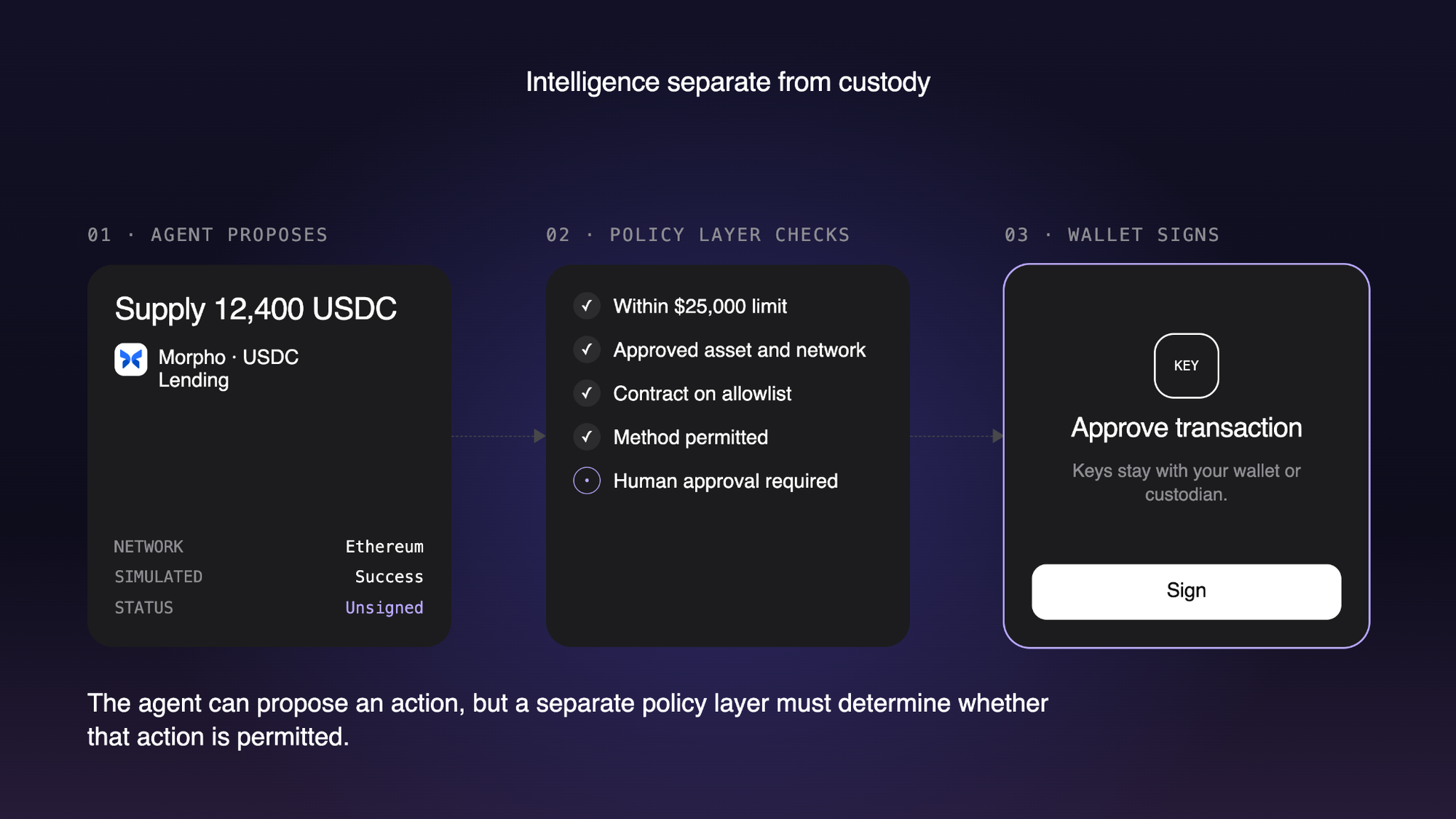
The second principle is that guardrails must be programmable. Production systems require enforceable transaction limits, approved assets and networks, contract allowlists, method-level permissions, and mandatory human approval for sensitive actions.
These controls must be enforced by the underlying infrastructure rather than by the agent’s prompt. The agent can propose an action, but a separate policy layer must determine whether that action is permitted.
The third principle is that recommendations must be inspectable. When a financial agent surfaces an opportunity, it should also explain why that opportunity is relevant. The user should be able to understand the expected return, source of yield, major risks, liquidity, fees, exit conditions, and available alternatives.
The options the agent rejected also matter. If it selects one product from hundreds, the user should understand which constraints shaped that decision.
The fourth principle is that existing financial platforms will be the primary distribution layer. Users do not need another application simply because it contains an agent. They want the products they already trust to become more intelligent.
Banks, wallets, exchanges, custodians, and fintechs already own the customer relationship. They understand the user’s identity, compliance status, assets, transaction history, and permissions. Agentic finance will therefore reach most people through these platforms, not around them.
The winning model is not an agent that replaces the financial institution. It is an intelligence layer the institution can embed while preserving its own experience, policies, compliance responsibilities, and custody architecture.
Infrastructure Needed for Intelligent Financial Interfaces
Three parts of the stack have matured at the same time to make this possible.
Financial data is becoming structured and machine-readable. Thousands of opportunities across lending, staking, vaults, and tokenized assets can now be queried through standardized interfaces rather than reconstructed from websites and protocol-specific data.
Wallet infrastructure can also process agent-prepared transactions safely. Policy engines, transaction simulation, MPC custody, smart accounts, and secure signing environments allow an agent’s output to be treated as a request rather than an instruction that must automatically be executed.
At the same time, models can increasingly compare alternatives and explain recommendations in language a user understands. They can connect portfolio context with market information, identify relevant trade-offs, and maintain a conversation across multiple financial actions.
Put these components together and something new emerges: an intelligence layer embedded inside a financial platform that understands the user’s portfolio, continuously evaluates the market, and helps the user act within the platform’s rules.
Active Oversight Across the Position Lifecycle
The relationship should not end when the transaction is signed.
A dashboard typically stops at the balance. A chatbot often stops at the answer. A financial agent should continue monitoring the position, and it should know when rates change, rewards become claimable, a lockup expires, risk increases, or an asset becomes idle. It should explain what changed and help the user rebalance, claim, withdraw, or exit.
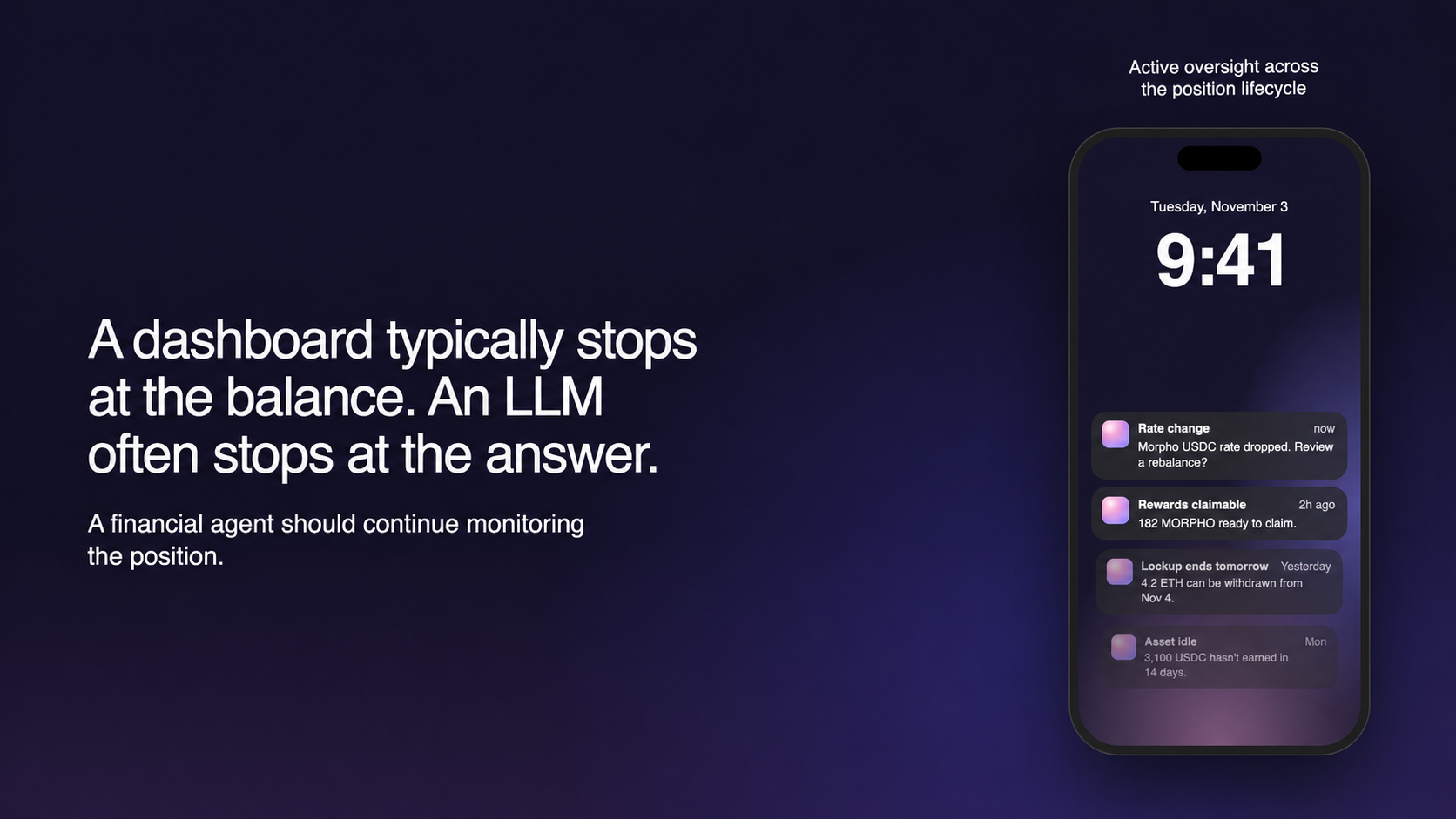
A financial agent should give users the sustained attention they would expect from a private banker who knows their holdings and follows their circumstances over time. Its authority to move money must remain explicit, with users and institutions setting permissions and platforms enforcing the applicable rules.
The Interface Race
The next generation of financial platforms will be judged by a different question.
The old question was: What can I buy here?
The new question will be: Does this product understand my situation, and can it help me decide what to do next?
The platforms that answer that question well will define the category. Those that place a chatbot beside an unchanged dashboard will mostly demonstrate what a financial agent is not.
As access expands, the competitive advantage shifts to how well a platform helps people use it. Private banks have long paired an understanding of each client’s finances with clear authority over what they can do on the client’s behalf. Financial agents need that same foundation: an informed view of the user’s circumstances and enforceable limits on every action they take.
The future of financial products belongs to the platforms that can provide both.